
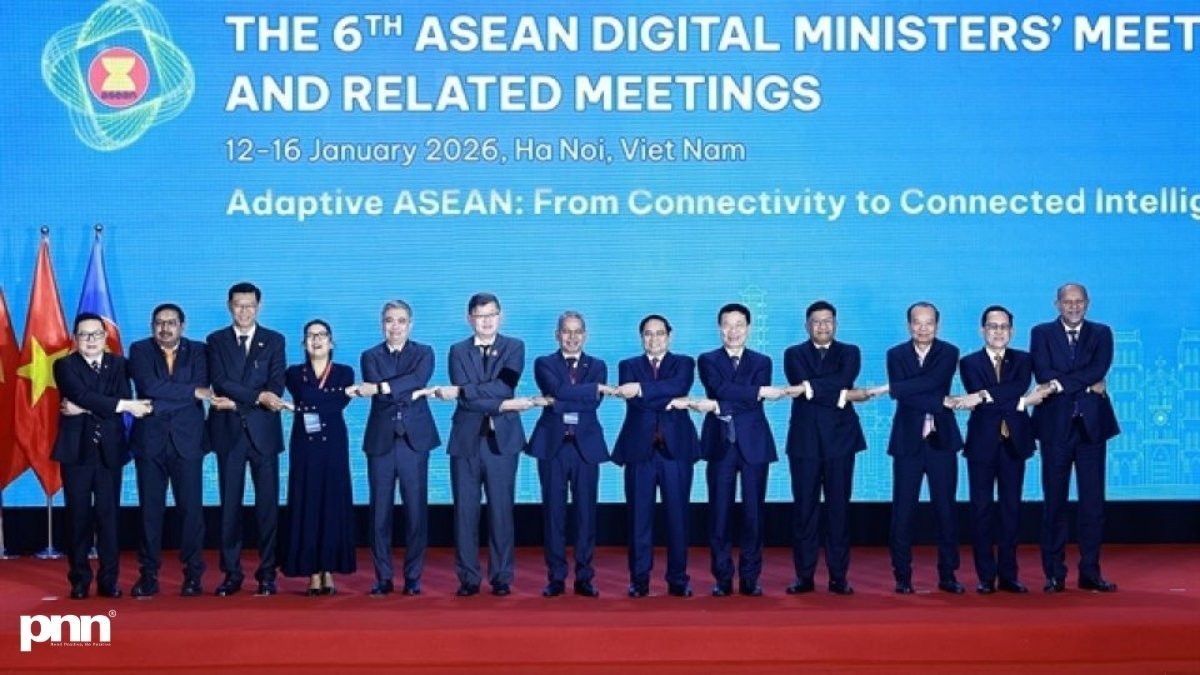
New Delhi [India], January 17: The collaborations and partnerships seem to be on their knees in this new era of technology due to their ability to innovate. This was evident through the 6th ASEAN-India Digital Ministers’ Meeting on January 16, 2026, which was conducted online but with India and member countries in ASEAN refocusing on this critical aspect. The meet was titled Adaptive ASEAN: From Connectivity to Connected Intelligence, but it was much more than that: it marked the inception of ASEAN’s future, and India was leading this.
Enhancing Dynamic Relationships in the Digital Age
Telecom and digital ministers of 11 member countries of the ASEAN, Brunei, Cambodia, Indonesia, Lao PDR, Malaysia, Myanmar, Philippines, Singapore, Thailand, Timor Leste, and Viet Nam and their dialogue partners Australia, Canada, China, EU, India, Japan, Korea, Russia, United Kingdom and United States were present in the conference.
The co-chairs, Shri Amit Agrawal, India, and Shri Nguyen Manh Hung, Viet Nam, not only networked but also mapped out the future path for ASEAN’s digital inclusion and integration.
India certainly was not a low-profile agenda. The country boasts global connectivity via 4G (almost everywhere), launched 5G faster than anyone else, and BharatNet in rural areas, which can be seen as strengths of economies of scale and strategic decision-making in the national agenda. Agrawal talked of Digital Public Infrastructure like Aadhaar, UPI and DigiLocker as the secret sauce that is catalyzing the growth story of the country. And that was not all – e.g., the scheme by India is called Sanchar Saathi, which protects telecom subscribers against fraud, is being replicated in the ASEAN region now.
India Digital Work Plan 2026
The best moment was the green light regarding the ASEAN–India Digital Work Plan 2026. Imagine it as a 12-month plan for making digital infrastructure smarter, safer, and more inclusive. It focuses on:
Capacity building and training in ICT.
The India- ASEAN Regulators Conference.
Implementation of telecom ICT solution.
Implementation of ASEAN-India Fund of Digital Future.
It is not just a case of bureaucratic paperwork. It is a roadmap of actionable regional projects that address the intersection of funding, training, and technological implementation.
AI and the Intelligence Leap
Connection was only the first step. The game-changing factor? Artificial Intelligence. The AI vision of India encompasses all things AI and prioritises trustworthy AI, although it has worked with ASEAN countries on AI standards and applications. Agrawal made it very practical and to the point: the next decade will be about AI, and it must be balanced with transparency.
A valuable lesson for the region is that the entire world is talking about smart cities and fintech, but India is demonstrating how digital transformation can be more inclusive, responsible, and achievable.
A Regional Prosperity Model.
This gathering made it clearer that both are aiming for a common goal: an open, secure, inclusive, and innovation-driven digital space. ASEAN and the Indian government are not just chatting; they are harmonising their policies and best practices, and developing interoperable systems that will have a direct impact on businesses, citizens, and the government.
For example, the fintech industry can easily implement cross-border payments, and data breaches can be avoided through cybersecurity across national borders. The trend of India signing up for the advancement of affordable, locally developed digital technologies within the region is a strong indication that ASEAN partners will not need to seek expensive technology from abroad.
Why This Matters to India
India plays two parts, participant and example. Its achievement in rural broadband, cellphone production, and digital government services provides a model of success for ASEAN nations with access disparities and regulatory loopholes. Through its experience, India becomes stronger in regional relations and establishes itself as a destination for tech and innovation in Asia.
This is especially applicable to startups, telecom operators and AI developers in India who now have an organized structure to explore ASEAN markets as they can contribute to the growth of the region.
Ahead: Between Connectivity and Connected Intelligence.
The 6th ADGMIN meeting was not just a networking event, but a strategic impetus to transform the region into a smarter, safer, and digitally literate region. The second step, after having training programs, regulatory alignment, collaboration with AI and funding mechanisms, is execution. And India is announcing it — we know it is not going to be a follower.
The Asian South East and the Indian digital future are not far away. It is an organized, strategic fact–and the plan is dynamic.